Platform Choice
Part of No-code costs and vendor risk: Bubble and Airtable
Comparing charges for users, records and app executions
Compare no-code pricing units using the same workflow assumptions, then check how Airtable, AppSheet and Bubble count growth.
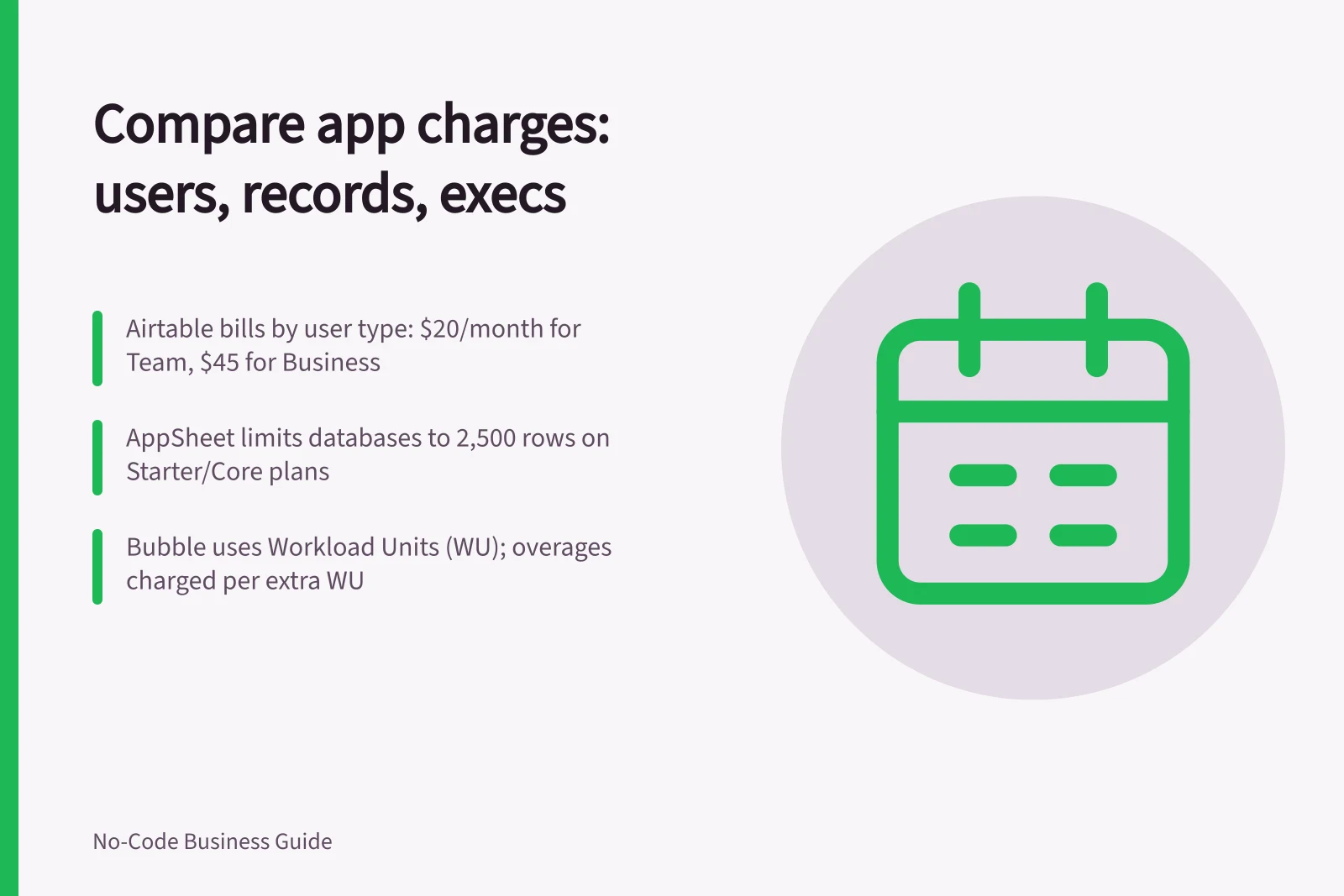
Growth changes different counters in Airtable, AppSheet and Bubble. Airtable charges for eligible editors and sets per-base record and monthly automation-run allowances; AppSheet charges per user and limits database rows; Bubble measures server demand in workload units (WU) and bills extra WU as overages.
These measures are not interchangeable: Airtable counts automation runs, AppSheet counts unique users across apps and databases, and Bubble aggregates server resources across processes. AppSheet Automation can move or update data in connected sources.
Forecast the work first
Forecast current use, a busy month and a plausible later stage. Count builders, internal users and external users separately, then count records in each relevant table, including records created by completed tasks.
Map events that may trigger automation or server work. Label unmeasured quantities as assumptions, and keep user counts, stored records, automation runs and Bubble WU as separate measures.
A service case might have a creation event, several status changes and a notification. Do not assume one case equals one execution: the configured trigger determines what is counted.
| Unit | Record for the comparison | Trap to avoid |
|---|---|---|
| People | Role, grant and expected use | Assuming all viewers or external users are free |
| Records | Table, data source and retention | Counting only the main table |
| Activity | Trigger, actions and frequency | Treating one page visit as one automation run |
Translate the provider rules
Airtable Free costs $0, and all users are free. Team costs $20 per user per month and Business costs $45 per user per month when billed annually; Enterprise Scale pricing is custom.
On Team and Business, a collaborator with edit permission for at least one base in the workspace is billable. Read-only collaborators, form submissions and share links are not, and editors added partway through a month are charged pro rata, only for the days after they were added.
Airtable's record limits per base and monthly automation-run allowances are: Free, 1,000 records and 100 runs; Team, 50,000 records and 25,000 runs; Business, 125,000 records and 100,000 runs; Enterprise Scale, 500,000 records and 500,000 runs.
Airtable does not sell extra records or runs one by one. At the record or attachment limit, bases stay usable and no data is removed, but no more records or attachments can be added until the plan is upgraded. Automations and API calls are capped at the current plan's limit.
AppSheet apps can be tested with up to 10 users at no cost. Its paid plans are Starter at USD $5 per user per month, Core at USD $10 and Enterprise Plus at USD $20 per user per month.
AppSheet counts each person who signs in to an app or AppSheet database as a user, counting unique users across apps and databases in the account. Rows per AppSheet database are 1,000 on Free, 2,500 on Starter and Core, and 200,000 on Enterprise Plus, where the sales team can raise the limit. Free and Starter allow 5 databases, Core 10.
When an AppSheet limit is reached, existing data is kept and stays readable and editable, but no new data can be added. Each paid AppSheet plan lists application and automation features, and process automation runs within limits such as 500,000 executions per day per app owner account for app change events.
Bubble offers Free, Starter, Growth, Team and Enterprise plans. Enterprise pricing is custom, and Free costs $0.
For Bubble Web-only plans, monthly prices with annual billing are $29 for Starter, $119 for Growth and $349 for Team; month-to-month prices are $32, $134 and $399. Mobile-only costs $42, $169 and $449 per month with annual billing, or $49, $199 and $529 month to month.
Bubble Web + Mobile costs $59, $209 and $549 per month with annual billing for Starter, Growth and Team, respectively; month-to-month prices are $69, $249 and $649. The plan prices vary by product track.
Bubble paid plans include monthly workload allowances of 175,000 WU for Starter, 250,000 for Growth and 500,000 for Team. Free includes 50,000 WU.
Bubble workload aggregates the server resources needed to host, run and scale an app across different processes; WU measures demand rather than counting app executions. Without a workload tier subscription, overages cost $0.30 per 1,000 WU. If overages are disabled and the limit is hit, the app is taken offline until more workload is added or the next billing period starts.
Find the first change that matters
For Airtable, compare records per base and automation runs per month with the selected plan's allowances. An added billable editor changes recurring charges on Team or Business, while reaching a record or run limit forces an upgrade rather than an extra charge.
For AppSheet, user growth is counted as unique sign-ins across apps and databases. A database approaching 2,500 rows on Starter or Core is the point where adding data stops, and AppSheet Automation can move or update data in connected sources.
For Bubble, compare WU with the plan's included workload before adding overage capacity. Set a workload alert below the allowance so a busy month is visible before it turns into overage charges.
Keep recurring user charges separate from record limits, automation-run allowances and workload measures. Neither a run allowance nor a WU total is a per-execution price.
Key pricing thresholds by platform
- Airtable - Billable editor threshold
- One editor with edit access to any base
- AppSheet - User count basis
- Unique sign-ins across all apps and databases