Data Modelling
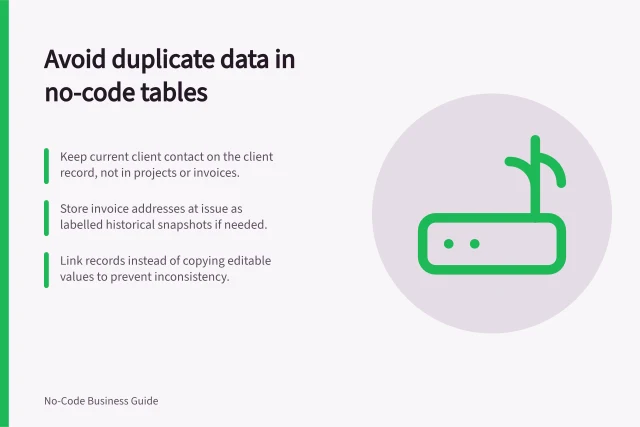
Avoiding repeated data in several no-code tables
Find conflicting copies of a fact, give current values one owner and distinguish linked displays from historical snapshots.

Section
Data Modelling
Find conflicting copies of a fact, give current values one owner and distinguish linked displays from historical snapshots.
Data Modelling
Plan an internal no-code app around one task, clear records, access rules, practical checks and ongoing ownership.
Data Modelling
Decide when a batch import or one-way feed is enough, and check matching, removal and product limits before adding two-way sync.
Data Modelling
Decide what one row represents and how to connect records with one-to-many, many-to-many or self-referencing relationships.
Data Modelling
Choose a stable row key, keep it distinct from a business identifier and plan how imports and relationships use it.
Data Modelling
Set a field-level data boundary for a no-code app, including sources, permitted actions, destinations and review triggers.
Data Modelling
Document a no-code formula's purpose, inputs, update timing, exceptions and examples so the next app owner can explain it.
Data Modelling
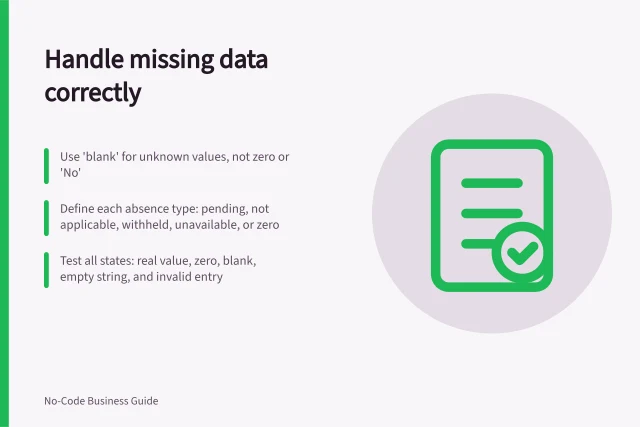
Keep unknown, zero and not applicable values distinct. Set requirements at the right step and make missing data clear in forms and reports.
Data Modelling
Choose the rounding point, precision and function for a no-code calculation, then check item totals, ties and negative values.
Data Modelling
Define no-code calculations and business rules, including inputs, missing values, rounding, checks and ownership.
Data Modelling
Plan the records, relationships and field ownership for a no-code app before building screens or importing data.
Data Modelling
Improve no-code database quality with clear field rules, duplicate controls, honest missing values, safer bulk edits and useful change history.
Data Modelling
Define record identity, warn on possible matches, enforce exact uniqueness where supported and check forms, imports and automations.
Data Modelling
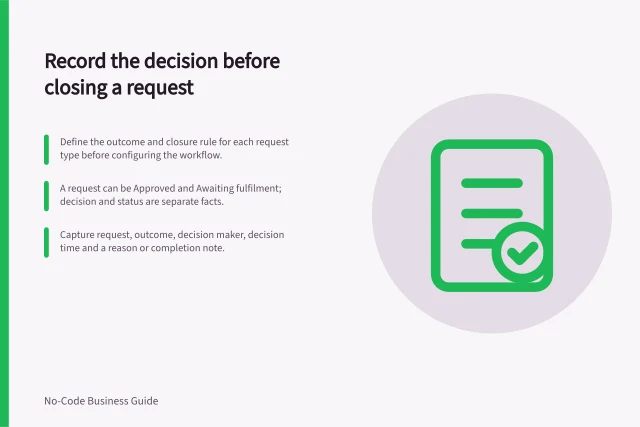
Define request closure, capture the outcome and decision maker, and keep a correction path for a request closed in error.
Data Modelling
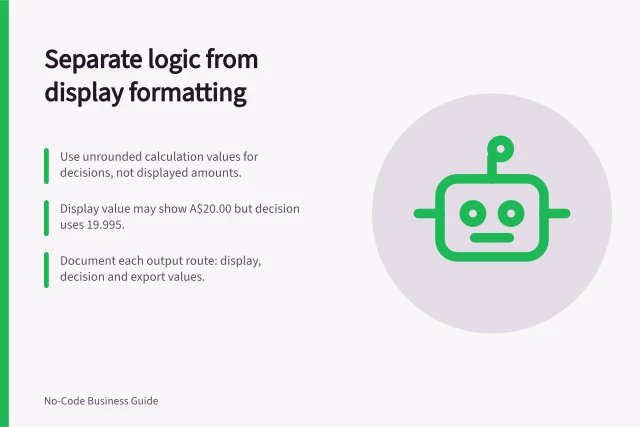
Keep numeric results, decision values and screen labels distinct so formatting does not silently change a no-code business rule.
Data Modelling
Build known-answer examples for a no-code calculated field, then compare results, displays and decisions after a change.