Permissions
Part of Building an internal request app
Assigning requests to an accountable owner
Set clear rules for request routing, named responsibility, reassignment and cover when an owner is unavailable.
Every open request needs someone responsible for its next action. A team queue can receive new work if a named coordinator watches requests not yet assigned to a worker. Define when a worker takes responsibility, how it transfers and who covers an absence.
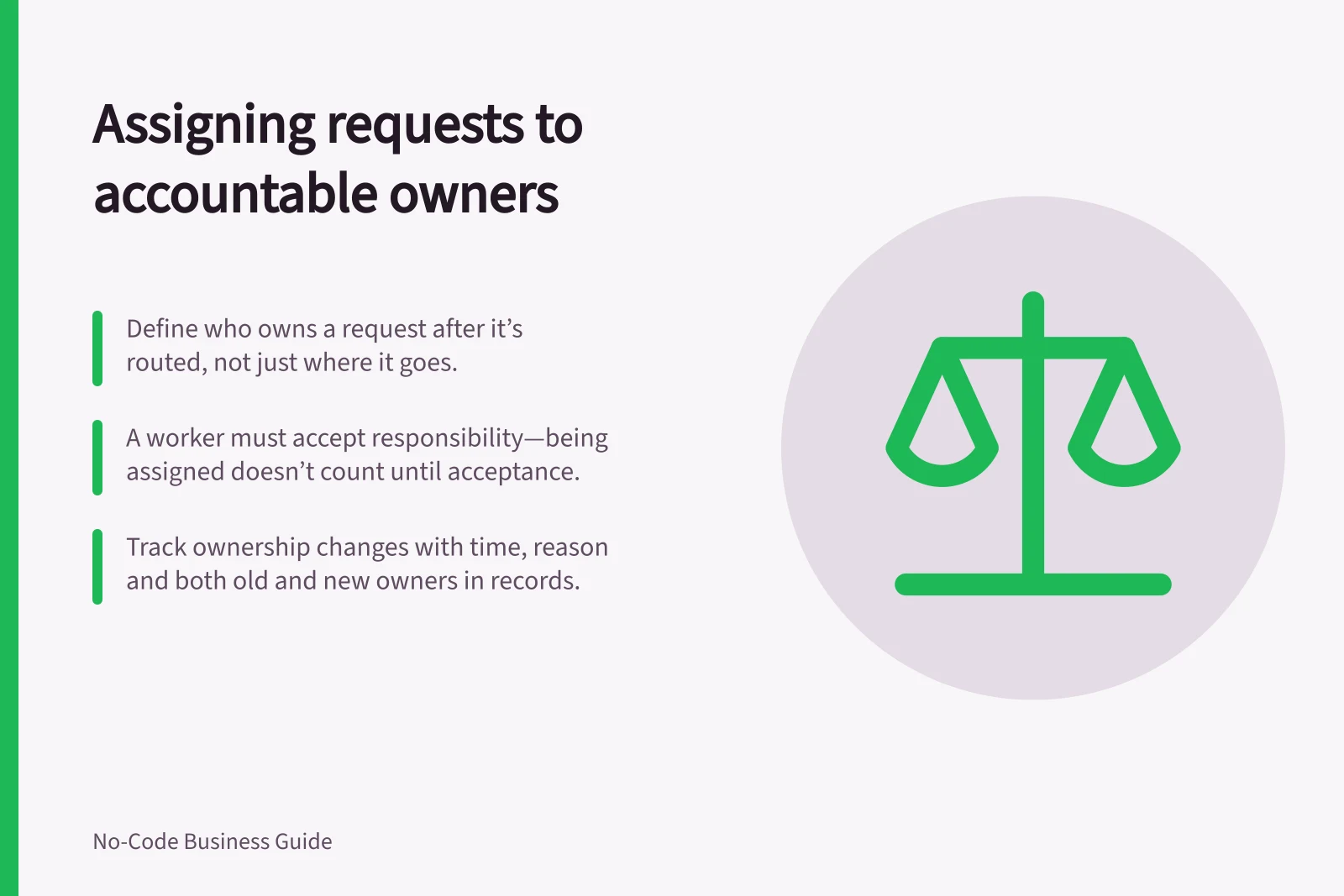
Separate routing from ownership
Routing answers “where should this go first?” Ownership answers “who is responsible now?” A category may send a facilities request to a queue without identifying an available worker. A coordinator can then assign a person, or the worker can explicitly accept it if that is how the team operates.
Choose what Assigned means. If it means a coordinator has nominated someone, say so. If it means the person has accepted responsibility, do not display it before acceptance. Keep unclaimed requests in a queue watched by the coordinator so a blank worker field does not make them disappear.
For each request type, write down the initial queue, who watches it and the event that transfers responsibility to a worker. A notification may draw attention, but the record should still show who must act.
Request Ownership Workflow
- Request enters queueSent to team queue by category (e.g., facilities, IT)
- Coordinator assigns workerNamed coordinator reviews and assigns to available worker
- Worker accepts or declinesWorker must explicitly accept to take ownership; unclaimed requests remain in queue
- Ownership confirmedSystem records owner, next action, and time of assignment
Acceptance vs. Nomination for Ownership
- Pros of Acceptance-Based OwnershipClear accountability; prevents forced assignments; reduces errors from incorrect nominations
- Cons of Acceptance-Based OwnershipRisk of delays if no one accepts; requires active engagement from workers
- Pros of Nomination-Based OwnershipFaster routing; ensures coverage even if worker is inactive
- Cons of Nomination-Based OwnershipMay lead to unassigned work if worker is unavailable; can create confusion if not properly communicated
Give the owner a next action
An owner may investigate, do the work, ask the requester for details, seek approval or return a misrouted request. If another person makes the final decision, distinguish the work owner from that decision maker.
Keep the current owner and next action easy to find. Record when responsibility changes. Where a handover needs an explanation, retain the previous owner, new owner, time and reason as an assignment event. A free-text note alone can make current ownership hard to determine.
Key Steps for Assigning Requests
- Define the next actionInvestigate, seek details, request approval, return misrouted request
- Track ownership changesRecord previous owner, new owner, timestamp, and reason for handover
- Avoid free-text only notesUse structured fields to ensure clear current ownership
Plan reassignment and absence
For a misrouted request, state who chooses the new destination and whether the incoming person must accept it. If acceptance is required, the outgoing owner or coordinator remains responsible during the gap. Make the request visible to that person until the handover completes.
Give a coordinator a way to find requests owned by staff who are away or have left. The coordinator needs authority to reassign them and should record the change. For escalation, define its trigger and recipient, and whether the current owner remains responsible. An alert should not silently remove an assignment.
Match access to the rule
A worker may need to edit their own assigned requests while a coordinator may need to reassign work across the team. Configure those actions in the chosen app and its data access path. A filtered My requests list helps a worker find tasks but does not, by itself, establish that other records are inaccessible.
Check the rule with ordinary accounts and fictional requests. Include a correctly routed request, one without a clear worker, a reassignment and an unavailable owner. At each step, inspect the stored owner or responsible coordinator, the relevant queue and what the requester sees.